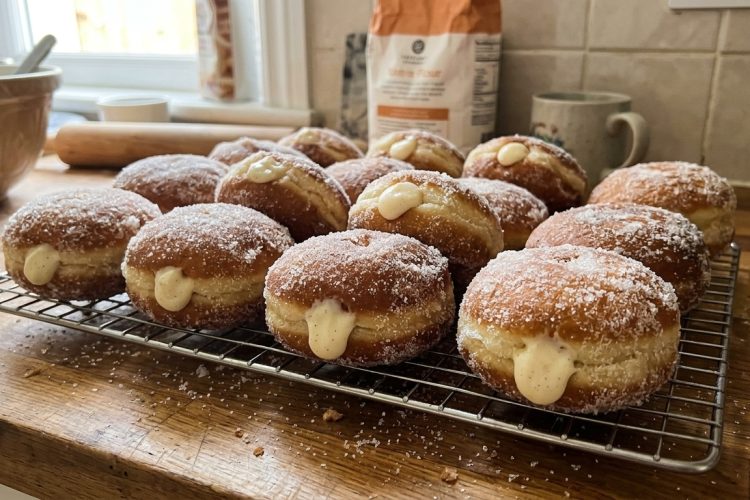
Sourdough discard custard-filled donuts are a delicious homemade treat featuring soft, fluffy dough, a smooth vanilla custard center, and a generous coating of granulated sugar. These donuts combine the familiar comfort of traditional yeast donuts with the mild flavor of sourdough discard, creating a bakery-style dessert that is perfect for breakfast, brunch, afternoon snacks, or special occasions. Each bite offers a tender exterior, a light interior, and creamy custard that makes these homemade donuts especially satisfying.
If you enjoy making recipes with leftover sourdough starter, these custard-filled donuts are an excellent way to put that discard to good use. Instead of throwing away unfed starter after feeding your sourdough, you can incorporate it into enriched donut dough for added flavor and a practical way to reduce waste. Active dry yeast helps the dough rise reliably, while milk, butter, egg, and sugar create a soft texture that pairs beautifully with homemade vanilla pastry cream.
The filling is just as important as the dough. A simple homemade vanilla custard made with egg yolks, whole milk, sugar, cornstarch, salt, and vanilla creates a rich, creamy center without requiring complicated techniques. Once the donuts are fried until golden brown and rolled in sugar, the chilled custard is piped inside, transforming ordinary homemade donuts into an impressive treat that looks and tastes like something from a neighborhood bakery.
What Makes These Sourdough Discard Donuts Special?
These sourdough discard donuts stand out because they combine two classic baking techniques in one recipe. The dough uses both sourdough discard and commercial yeast, while the filling follows the traditional method for making vanilla custard on the stovetop. This combination allows you to enjoy the flavor of sourdough without depending entirely on natural fermentation for the rise, making the recipe more predictable for home bakers.
Another appealing feature is the contrast between the textures. The fried dough develops a lightly crisp, golden exterior while remaining soft and airy inside. The sugar coating adds a delicate sweetness and a slightly grainy finish that complements the smooth filling. When you bite into one, the creamy custard balances the richness of the fried dough, creating a dessert that feels indulgent without being overly complicated to prepare.
These donuts are also versatile enough for different occasions. Serve them alongside coffee for a weekend breakfast, arrange them on a platter for brunch, or prepare them as a homemade dessert for family gatherings. Because they are filled with vanilla custard rather than a heavy frosting, they have a classic appearance and a familiar flavor that appeals to people who enjoy traditional European-style filled donuts.
Shaping the Donuts for Even Results
Lightly flour your work surface and roll the dough to approximately half an inch thick. Use a round cookie cutter or the rim of a glass to cut out circles. Press straight down instead of twisting the cutter, because twisting can seal the edges of the dough and interfere with an even rise. Gather the remaining scraps, roll them out again, and continue cutting until all the dough has been used.
Place each round on an individual square of parchment paper. These small pieces make it easier to move the delicate dough without stretching or flattening it. Arrange the shaped donuts with enough space between them so that they can expand during the second rise. Cover them lightly with plastic wrap or a clean, lightweight towel to prevent their surfaces from drying out.
Allow the shaped donuts to rise for another one to two hours, or until they look visibly puffy and nearly doubled in size. They should feel light and airy, and a gentle fingertip press should leave an indentation that returns slowly. This second proofing stage is especially important because it helps create the soft, open interior that pairs so well with creamy vanilla custard.
Underproofed donuts tend to be dense and may not develop the desired texture during frying. On the other hand, dough that becomes excessively fragile can be difficult to transfer without deflating. Keep the donuts covered, monitor their appearance, and handle them gently when moving them toward the hot oil.
Frying Sourdough Discard Custard-Filled Donuts
Heat the Oil to the Correct Temperature
Pour two to three inches of neutral oil into a heavy-bottomed pot. Suitable options include vegetable oil, coconut oil, and avocado oil. Heat the oil to 340–360°F, using a cooking thermometer to monitor the temperature. Maintaining the correct heat is one of the most important steps in frying donuts because oil temperature affects browning, cooking time, and the amount of oil absorbed by the dough.
Oil that is too hot can brown the outside before the center has cooked properly. If the oil is too cool, the donuts may absorb excess oil and become greasy rather than light. A heavy-bottomed pot helps distribute heat more evenly, while a thermometer makes it easier to maintain a steady temperature as each batch cooks.
Fry Until Golden Brown
Carefully lower the proofed donuts into the oil in small batches, leaving enough space for them to move freely. Parchment squares can help transfer the delicate rounds into the pot; remove the paper with tongs once it releases. Fry the donuts for approximately one to two minutes per side, until they become golden brown and cooked through.
Avoid overcrowding the pot because adding too many donuts at once can cause the oil temperature to drop. Frying two or three at a time is a practical approach for many home kitchens, although the exact number depends on the size of the pot. Allow the oil to return to the target temperature between batches to keep the results consistent.
Use a slotted spoon or suitable kitchen utensil to remove the finished donuts safely. Transfer them to a wire rack with parchment paper underneath to catch drips. While they are still warm, roll each donut in the granulated sugar until the surface is evenly coated. Return them to the rack and allow them to cool completely before adding the custard.
Filling the Donuts With Vanilla Custard
Once the donuts have cooled, transfer the chilled vanilla custard to a piping bag fitted with a round tip. If the custard has become very firm during refrigeration, gently stir it until it is smooth enough to pipe. Avoid warming it excessively because the filling should remain chilled and thick enough to stay inside the donuts.
Use a small knife to create an opening in the side of each donut. Insert the piping tip into the opening and squeeze gently, allowing the custard to move into the center. You may notice the donut expanding slightly as the filling enters. Stop when the donut feels full but still holds its shape. Overfilling can cause the custard to leak through the opening or split the soft dough.
For the neatest presentation, fill the donuts shortly before serving. This helps preserve the contrast between the fluffy dough and creamy filling. Arrange them on a serving plate with the sugar coating visible, and serve while the donuts are fresh. If you want to show the custard inside, cut one donut in half just before serving so the creamy center remains attractive.
Storage and Make-Ahead Instructions
Sourdough discard custard-filled donuts are best enjoyed on the day they are made, when the fried dough is at its softest and the sugar coating is fresh. The contrast between the tender exterior and creamy center is especially pleasant soon after filling. If you are preparing them for guests, consider completing the custard and dough preparation in stages so that the donuts can be filled closer to serving time.
Because these donuts contain homemade milk-and-egg custard, refrigerate leftovers in an airtight container and consume them within three days. Do not leave the filled donuts at room temperature for extended periods. For the best texture, allow a refrigerated donut to sit briefly before serving, but keep this time short and return any remaining portions to the refrigerator.
If you want to prepare parts of the recipe ahead, the custard can be made first and chilled until needed. The dough is best managed according to its rising schedule, with attention to temperature and proofing. Avoid filling the donuts too early if you want to preserve their texture, as the custard can gradually soften the interior during storage.
Frequently Asked Questions
Can I Use Active Sourdough Starter Instead of Discard?
Yes, you can use active, bubbly sourdough starter instead of unfed discard. However, this recipe also uses active dry yeast, which provides the main rise within the stated preparation schedule. Keep the starter’s consistency in mind because differences in hydration can affect the dough slightly. The dough should remain soft and elastic rather than stiff or excessively wet.
Why Is My Vanilla Custard Lumpy?
Custard can become lumpy if the egg yolks cook too quickly, the milk is added too rapidly, or the mixture is not whisked continuously. Tempering the yolks slowly helps prevent this problem. If small lumps develop, strain the custard through a fine-mesh sieve while it is still warm, then cover the surface and refrigerate until completely chilled.
How Do I Know When the Donut Dough Is Ready?
The dough should look smooth, feel elastic, and pull away from the sides of the mixing bowl after kneading. During the first rise, it should approximately double in size. After shaping, the donuts should become puffy and respond slowly when pressed gently with a fingertip. These signs are more reliable than following a fixed time alone because room temperature affects yeast activity.
Can I Fill the Donuts While They Are Warm?
It is better to let the donuts cool completely before filling them. Warm dough can soften the chilled custard and make it runnier, which increases the chance of leakage. Cooling also makes the donuts easier to handle without damaging their shape. Once the donuts have cooled, pipe the custard into the center and serve them as soon as practical.
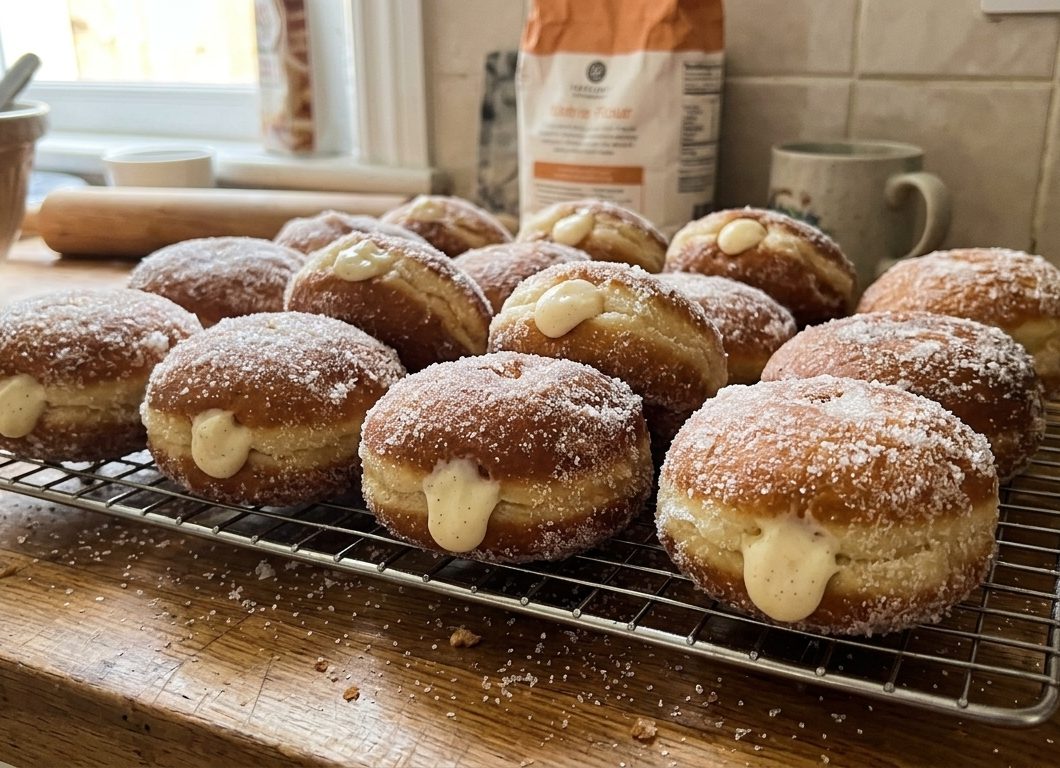
Sourdough Discard Custard-Filled Donuts
 Recipe by admin
Soft, fluffy sourdough discard donuts filled with smooth homemade vanilla custard and coated in granulated sugar.
12
servings30
minutes24
minutes240
kcal240
minutes4
hours54
minutesIngredients
- For the Vanilla Custard
5 large egg yolks
1/4 cup cornstarch (30 g)
2 cups whole milk (480 g)
1/2 cup granulated sugar (100 g)
1/4 teaspoon salt (1.5 g)
1 teaspoon vanilla extract or vanilla bean paste (5 g)
- For the Donut Dough
2/3 cup warm milk (150 g), approximately 105–110°F
2 1/4 teaspoons active dry yeast (7 g)
1/4 cup granulated sugar (50 g)
1 large egg (50 g), at room temperature
1 teaspoon salt (6 g)
3/4 cup unfed sourdough discard (200 g)
3 1/2 cups all-purpose flour (425 g)
5 tablespoons salted butter (75 g), at room temperature
- For Frying and Coating
Neutral oil for frying, approximately 2–3 inches deep; coconut, avocado, or vegetable oil
1 1/2 cups granulated sugar (300 g), for coating
Directions
- Whisk the egg yolks and cornstarch in a medium bowl until completely smooth.
- In a saucepan over medium heat, combine the whole milk, sugar, and salt. Heat until steaming but not boiling.
- Slowly whisk approximately 1 cup of the hot milk into the egg mixture to temper the yolks.
- Gradually pour the tempered egg mixture back into the saucepan while whisking continuously.
- Cook over medium heat for 3–5 minutes, whisking constantly, until thick and creamy.
- Remove from the heat and stir in the vanilla extract or vanilla bean paste.
- Transfer to a bowl, press plastic wrap directly onto the custard’s surface, and refrigerate for at least 2 hours or until completely chilled.
- Combine the warm milk, active dry yeast, and sugar in a small bowl. Let stand for 5–10 minutes until foamy.
- Add the yeast mixture, egg, salt, sourdough discard, and flour to a stand mixer fitted with a dough hook.
- Mix on medium speed until the ingredients are combined.
- Add the room-temperature butter one tablespoon at a time, allowing each addition to incorporate before adding the next.
- Add the room-temperature butter one tablespoon at a time, allowing each addition to incorporate before adding the next.
- Knead on medium-high speed for 8–10 minutes until the dough is soft, smooth, elastic, and pulling away from the bowl.
- Transfer the dough to a lightly oiled bowl.
- Cover and leave in a warm place for approximately 2 hours, or until doubled in size.
- Gently press down the risen dough and roll it out on a lightly floured surface to about 1/2-inch thickness.
- Cut into rounds using a cookie cutter or the rim of a glass. Re-roll the scraps and cut additional rounds.
- Place each donut on an individual square of parchment paper.
- Cover lightly and let rise for 1–2 hours, until puffy and nearly doubled in size.
- Heat 2–3 inches of neutral oil in a heavy-bottomed pot to 340–360°F.
- Carefully lower the donuts into the oil in small batches, removing the parchment with tongs once it releases.
- Fry for 1–2 minutes per side, until golden brown and cooked through.
- Transfer to a wire rack with parchment underneath.
- While still warm, roll each donut in the granulated sugar until evenly coated.
- Allow the donuts to cool completely before filling.
- Transfer the chilled vanilla custard to a piping bag fitted with a round tip.
- Use a small knife to make an opening in the side of each cooled donut.
- Pipe custard into the center of each donut until filled, taking care not to overfill.
- Serve fresh for the best texture and flavor.
Notes
- Temper the egg yolks slowly while whisking to prevent scrambling.
- If the custard becomes lumpy, strain it through a fine-mesh sieve while warm.
- The custard thickens further as it chills, so remove it from the heat once thickened.
- If the yeast does not foam, check the milk temperature and yeast freshness before continuing.
- Keep the dough soft and slightly tacky; avoid adding excessive flour.
- Use room-temperature butter for easier incorporation.
- Press the cookie cutter straight down without twisting.
- Proof the shaped donuts until puffy to help prevent dense results.
- Maintain the oil temperature between 340–360°F and fry in small batches.
- Fill the donuts shortly before serving for the freshest texture.
- Storage: Best enjoyed the same day. Refrigerate leftovers in an airtight container for up to 3 days because the custard contains milk and eggs.
Nutrition Facts
- Calories: 240kcal
- Fat: 9g
- Carbohydrates: 74g
- Fiber: 1g
- Sugar: 40g
- Protein: 8g